
Wojciech Cieśniewski (1958)
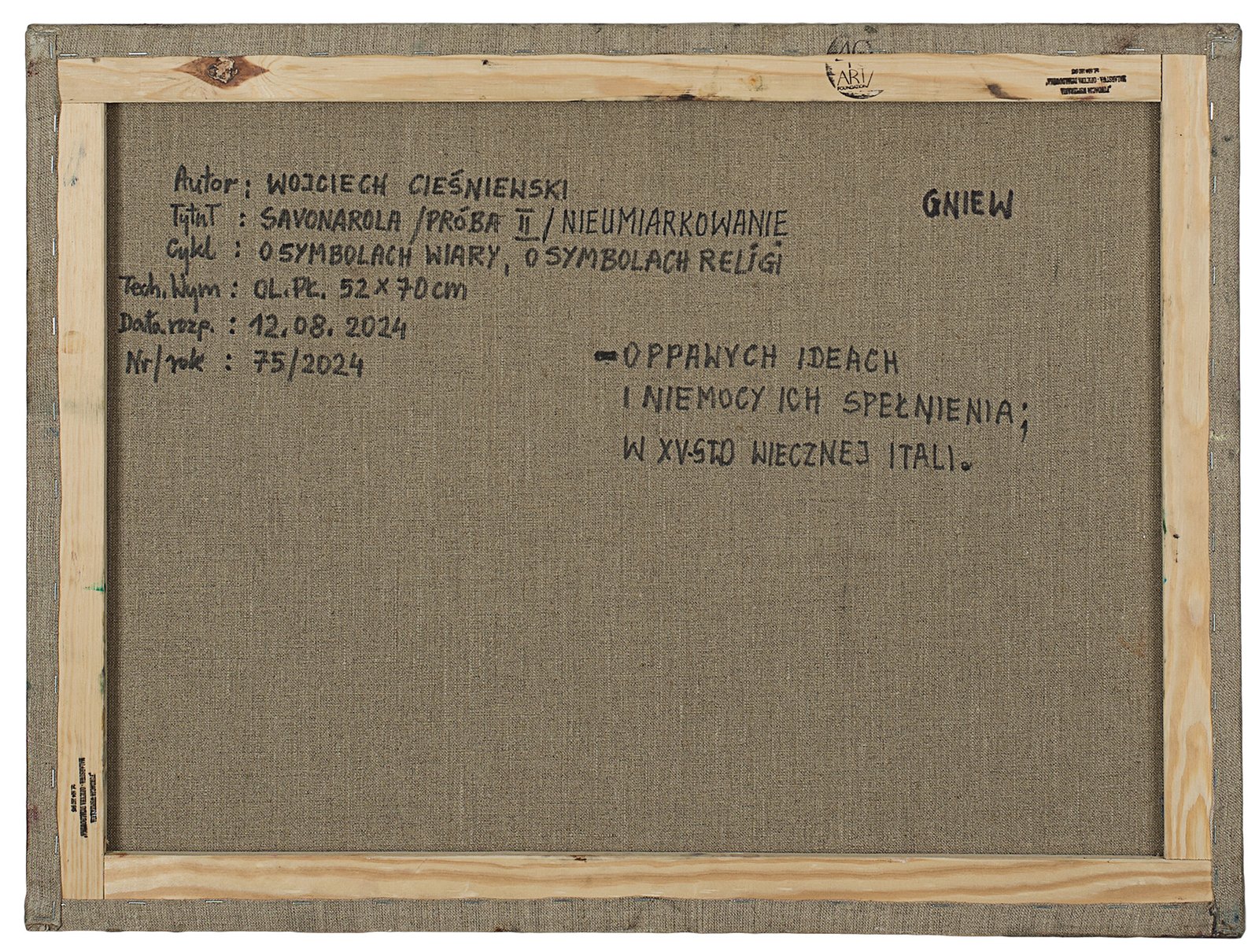
52 x 70 cm / oil on canvas / XVI century technique
Story by Dr Grażyna Bastek and Aron Pudelko, curators. Read the full transcript:
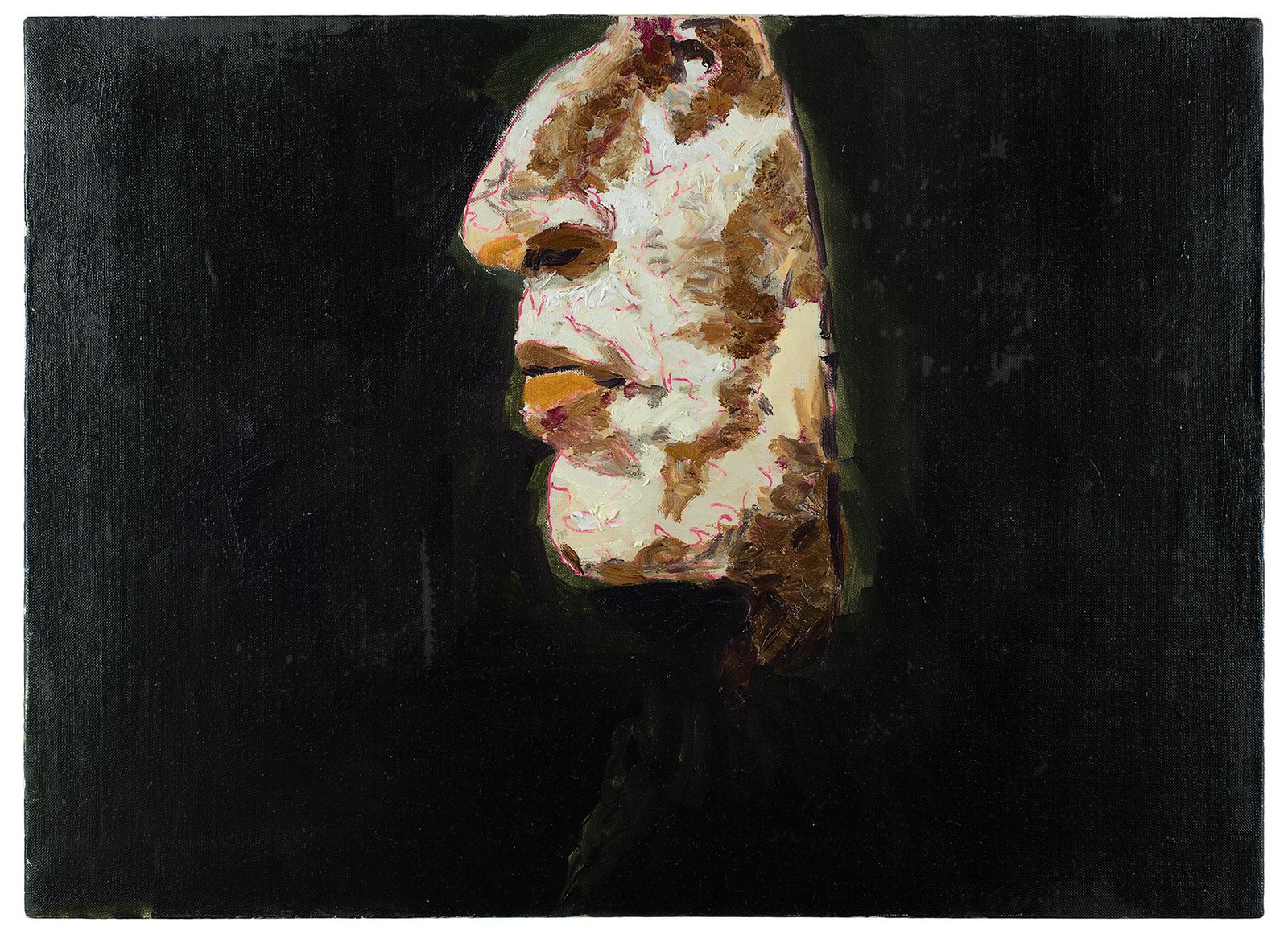
In Wojciech Cieśniewski’s paintings, the narrator isn’t just the figure on the canvas. It’s also the light, the texture, the way the paint is laid down, the intensity of the gesture. These are elements of his visual language, and they speak just as powerfully as the subject itself. In the painting titled “Wrath”, everything speaks. Every brushstroke. Every crack of shadow. Here, even the darkness has a voice. The artist doesn’t just depict emotion—he paints with emotion. He doesn’t just show wrath; he paints through wrath.
We recognize the iconic figure of the Renaissance preacher Girolamo Savonarola. But Wojciech Cieśniewski severs the body and immerses it completely in blackness. There is no background, no escape, only anger. It lives in the eyes, in the folds of the face, in the crushing weight of shadow. Wrath is not just a facial expression here. It is a wave of darkness, a pain that festers inside and eventually spills out.
Wrath is a sorrow about something we cannot change. A silent, burning rot that breaks through the surface. And that is exactly what we see in this painting. Savonarola’s face seems almost corrupted. His features scorched by the fire of his own emotion. But Wojciech Cieśniewski doesn’t judge. He invites us to ask: What is wrath? Can we understand it? Can we face it?
The painting “Wrath” isn’t just a painting. It is a mirror for those struggling with their own past wounds, their hidden shadows, their trauma. The artist seems to whisper: these heavy emotions will only crush us unless we forgive. Only through forgiveness can we begin to fight for ourselves. And that is the true power of his work.
“Wrath” is the central piece of the exhibition “Faces of the Soul: Virtues and Vices”. It doesn’t just hang on the wall. It moves you. It lingers. It asks you to look deeper.
90000,00 zł
The exhibition “The Faces of the Soul: Virtues and Sins”, initiated by the 407 Art Foundation in 2025, is an attempt to redefine concepts deeply rooted in culture – concepts that have shaped humanity’s moral compass for centuries. Wojciech Cieśniewski takes on a bold challenge: he examines the evolution of these notions in the context of contemporary social and cultural transformations. Has what was once considered a sin become merely a personality trait today?
Do virtues, which once defined the ideal human, still carry the same weight in a reality where everything is subject to redefinition? Cieśniewski does not offer easy answers. Instead, he compels the viewer to reflect, holding up a mirror in which one can see both oneself and society. His works balance on the edge of consciousness and subconsciousness – they are emotional, provocative, and intellectual.
The Artist, Painter, Professor of Art. Born in 1958 in Działdowo, Wojciech Cieśniewski initially pursued a passion for theoretical mathematics, earning a Master’s degree from the Higher Pedagogical School in Olsztyn in 1984. During his studies, he discovered that the language of mathematical symbols could not adequately express his emotions.
In 1983, he began studying at the Academy of Fine Arts in Warsaw, where he graduated with distinction in 1988 under the mentorship of Prof. Rajmund Ziemski. Since 1990, he has been a faculty member at the academy, serving as Vice Dean of the Faculty of Painting from 2005 to 2012. Currently, he leads his own diploma studio.
Cieśniewski is considered one of the most significant contemporary Polish painters, recognized for both his artistic and intellectual achievements. For the first two decades of his career, he explored abstraction, investigating the autonomy of meaning and the impact of visual language in painting. In later years, he returned to figurative painting, engaging in a dialogue with the traditions of European art, drawing inspiration from masters such as Caravaggio, Giotto, Michelangelo, Gian Lorenzo Bernini, and Vermeer.
Over time, his work increasingly addressed ethical questions and the broader themes of good and evil in human life, while examining the role of art as a vehicle for beauty and virtue. His paintings often draw upon themes from the Bible, mythology, Christian iconography, and history.
Wojciech Cieśniewski has received numerous awards, including the Special Merit Award at the 2nd Malaysia International Art Exhibition (2012) and the “Gloria Artis” Medal for Merit to Culture (2011). His works have been featured in over 150 individual and group exhibitions in Poland and abroad.
 English (UK)
  Polski